“Now is the time that we make conscientious efforts towards becoming a real wise species, free from all sorts of bigotry and sectarianism.”
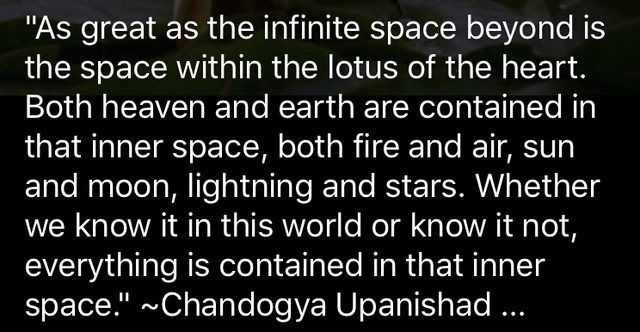
“Now is the time that we make conscientious efforts towards becoming a real wise species, free from all sorts of bigotry and sectarianism.”
Direct your mind inward, and you’ll find a thousand regions of your mind yet undiscovered. Travel them…
Our roots are in space and eternity. Not in the earth and time. Our minds, the subtler parts of our own imaginations, break through the boundaries of physical things. We are in this physical world, but definitely not of it.

In fact reality can only be attained within and not without ourselves. Man should turn his gaze within in order to begin that most marvelous of all explorations, since happiness comes only from within. The "divine strain" hums all around us, yet we are of so gross a nature that we hear it not! Only by entering into the divine silence and closing our ears to the world of illusions can we catch the celestial melody or else we are yielding to the illusions of our imagination and reaping bitter misery.

Hinduism has a complicated system of belief in the individual soul, as well as in a universal soul, which can be thought of as a single deity--God. Hindus believe that all creatures have a soul, a true self known as ātman. There is also a supreme, universal soul, known as Brahman, which is considered distinct and different than the individual soul. Diffferent schools of Hinduism may worship the supreme being as Vishnu, Brahma, Shiva, or Shakti, depending upon the sect. The goal of life is to recognize that one's soul is identical to supreme soul, and that the supreme soul is present everywhere and that all life in connected in oneness. In Hindu practice, there is a multitude of gods and goddesses that symbolize the one abstract Supreme Being, or Brahman. The most fundamental of Hindu deities are the Trinity of Brahma, Vishnu, and Shiva. But many other gods such as Ganesha, Krishna, Rama, Hanuman, and goddesses like Lakshmi, Durga, Kali and Saraswati top the popularity chart with Hindus across the world.

To effectively convey the meaning of the supra-mundane state in ordinary language, the Upanisadic thinkers projected the state of liberation – the real happiness – as great Self (Ātman) as well as the eternal Brahma. When one renounces or contains all desires, one becomes great Self (Ātman)/Brahma. The Upanisadic thinkers also taught that one’s ‘inner soul’ (antarātman) is in fact the great Self/Brahma, and that one can discover it.
The poet of KaṭhaUp 5.12 supported the theory of an original pure soul and asserted that the ‘Inner Soul (antarātman)’ is in all things and that those wise people who can see it have eternal happiness. This poet added that this inner soul is ‘the Constant among the inconstant, the Intelligent among the intelligences’ (KaṭhaUp 5.13).27
That is, there is a permanent self in impermanent beings. This idea – the inner self is pure and it must be realised or recovered – was also shared by the Buddha. He told his monks that the original mind (citta) is luminous but is defiled by taints and is to be cleansed (AN I 10). However, the Upanisadic thinkers and the Buddha do not share the same terminologies.
The Upanisadic thinkers named the original pure mind as ‘inner soul’. The Buddha felt that since the original mind is pure and does not have any mundane or worldly feeling, it cannot be termed as ‘self’

'Spiritual Knowledge and Vision is dependent upon the realization of certain eternal truths, something which arises from the fount of the soul. It cannot be passed from one who has had it to another who has not.
The sense of it however can be communicated in a structure or form which may inspire a recognition in others. To enter into the thoughts of the Spiritual Sages, one has to allow their words to sink into our souls to mold our thoughts and create their own reverberations in a sympathetic resonance.
Their knowledge was accessible by listening to the old voices and allowing the "Sruti" (resonance) in the Soul to respond, to vibrate to the Vedantic hymn of knowledge and to allow that response to gradually gain in clarity, intensity and fullness.'
The Ground of all being is a spiritual Absolute ineffable in terms of discursive thought but susceptible of being directly experienced and realized by the human being. It is the Divine Self, same in each, One in All.
" The Self is Being, not a being. By self is meant the conscious essential existence, one in all. Self is the fundamental aspect of the Brahman with a certain stress on impersonality. It is omnipresent, same in everything, intimate, pure and intangible.
The Self can be experienced as the self of the individual. It is at the same time universal. Self is that aspect of the Brahman in which it is intimately felt as at once individual, cosmic and transcendent."
"To realize Self is to realize the eternal freedom of the spirit. The first realization of the Self as something intensely silent and purely static is not the whole truth of it. There can also be a realization of the Self in its power. Establishing the mind in the Self means the conviction that the self alone is all, and that there is nothing other than it.
As ones process deepens, the pervasive sense of coolness and calmness shows that the consciousness is reorienting itself at a deeper level of the being. Joy and happiness not dependent upon outward things begins to manifest. One becomes aware that he is acted through and totally dependent upon the Divine.
This realization and accompanying release into peace and happiness is spoken of as liberation and carries with it the value of being released from jail. One begins to feel that the ordinary consciousness is something quite external and on the surface. It does not seem to be ones real self." Sri Aurobindo "The Life Divine"
The Four Great Yogic Sayings or "Mahavakyas" 1.) Consciousness [as manifest in an individual] is Brahman [God] 2.) I am Brahman [Consciousness] 3.) Thou Art That 4.) This Atman [the individual self] is Brahman

Meditation is a long journey, a pilgrimage into the mind itself. Generally we become aware that there is such a thing as meditation after the material world has lost its attraction to us and previous desires no longer bind us to patterns of fear, greed, attachment and ramification. We then seek through philosophy and religion to answer the questions, "Who am I? Where did I come from? Where am I going?" We ask others. We read books. We ponder and wonder. We pray. We even doubt for a while that there is a Truth to be realized, or that we, with all our seeming imperfection, can realize it if it does exist. Oddly enough, this is the beginning of the meditator's journey on the path, for we must empty ourselves fully before the pure, superconscious energies can flow freely through us. Once this state of emptiness and genuine searching is reached, we soon recognize the futile attempt to find Truth on the outside. We vividly begin to know, from the depth of ourselves, a knowing we could not explain or justify. We simply know that Reality, or the Self God, resides within, and we must go within ourselves to realize it. Of itself, that knowing is not enough. Even great efforts to meditate and vast storehouses of spiritual knowledge are not enough. Many have tried to find the Truth this way. The Truth is deeper and is discovered by the resolute devotee who dedicates his life to the search, who lives a balanced life according to the yamas and niyamas, the Vedic spiritual laws, who willingly undergoes change, who finds and obeys a spiritual teacher, or satguru, and who learns precisely the disciplined art of meditation. This, then, outlines the destination of the meditator's journey and his means of travel.

"I become a subject in dream; and I am a subject in the waking state also. The question that we have to put here is: Is this dreaming individual who is different from the dream-objects the same as the waking individual who is different from the objects of waking experience? If we think carefully over the issue, we will find that they are different from each other. The waking individual contains within himself the dream-subject as well as the dream-objects. It is the waking subject that has externalised his ideas as the dream-subject and his universe. When we wake up we find that not only the dream-universe is not there, but the dream-subject, also, is not there. The dream-subject and the dream-objects are unified in the waking subject. This can give us a clue to the relation of the individual to the universe. Even as the dream-subject is different from the dream-objects, this waking subject is different from the waking universe; but even as the dream-universe is not created by the dream-subject, so the waking universe is not the product of the waking subject. And, even as the subject and the objects in the dream state are resolved into another subject in the waking state, the waking subject and the waking universe are resolved into another subject which is Purushottama or Virat. Ishvara contains in himself all the objects and subjects. The universe is the objectification of the Cosmic or Universal Consciousness, and not of any individual mind. Ishvara is the Soul of the universe, the Cosmic Self, the Cosmic Mind, who is the efficient and material cause of the individual minds; the individual has no independent existence apart from Ishvara; God includes in himself both mind and matter. Brahman (the Absolute) is Ishvara divested of cosmic relations, and Ishvara is Brahman in relation to the cosmos"


