Thursday, March 19, 2020

~ Rumi

“I open and fill with love
and what is not love evaporates.

All the learning in books stays put
on the shelf. Poetry, the dear
words and images of song, comes down
over me like mountain water.”


Awakening the Cobra: The Birth of Tantra

Awakening the Cobra: The Birth of Tantra

Article by Meloney Hudson, Ipsalu Tantra teacher
Several millennia ago, spiritual adepts in the East, recognizing the dynamic energies of the universe and human body, identified sexual energy as a vehicle for enlightenment. Those of us raised in the puritanical Western churches probably see any kind of sexual ritual as the antithesis of religious enlightenment, but practitioners of the cult called Tantra that arose in Asia around 1,400 years ago discovered, refined, and disseminated practices with sexual energy as a path of spirituality through ecstasy.
The word Tantra comes from two Sanskrit words, “tanoti”, meaning “to expand,” and “trayati”, or “liberation.”1 Through the practices of Tantra, one’s awareness of the soul would expand, causing liberation from the confines of physical limitations. A path based on energy, Tantra is a practice in which sexual energy is generated and harnessed for purification of the energetic body. By merging feminine and masculine energies, either within one’s own body or by merging souls with a beloved partner of opposite energies (such as masculine and feminine), a pathway can be created through which energetic communion with the Higher Power could occur. Enlightenment and bliss are the rewards


Empire of the senses

Empire of the senses

All we have to believe with is our senses: the tools we use to perceive the world, our sight, our touch, our memory. If they lie to us, then nothing can be trusted. And even if we do not believe, then still we cannot travel in any other way than the road our senses show us; and we must walk that road to the end.
–Neil Gaiman
American Gods


Wednesday, March 18, 2020

stay at the center of the circle and let all things take their course. —Lao Tzu

Crimson gleams of Matter, gliding imperceptibly into the gold of Spirit, ultimately to become transformed into the incandescence of a universe that is person- and through all of this there blows, animating it and spreading over it a fragrant balm, a zephyr of union- and of the Feminine.

The diaphany of the Divine at the heart of a glowing universe, as I have experienced it through contact with the earth- the divine radiating from depths of blazing matter.


[...]


…the world will open the arms of God to us. It is for us to throw ourselves into these arms so that the divine milieu should close around our lives like a circle.


—Teiljard de Chardin
The Divine Milieu


John Muir

One is constantly reminded of the infinite lavishness and fertility of Nature — inexhaustible abundance amid what seems enormous waste. And yet when we look into any of her operations that lie within reach of our minds, we learn that no particle of her material is wasted or worn out. It is eternally flowing from use to use, beauty to yet higher beauty; and we soon cease to lament waste and death, and rather rejoice and exult in the imperishable, unspendable wealth of the universe, and faithfully watch and wait the reappearance of everything that melts and fades and dies about us, feeling sure that its next appearance will be better and more beautiful than the last.
... More and more, in a place like this, we feel ourselves part of wild Nature, kin to everything.


... This star, our own good earth, made many a successful journey around the heavens ere man was made, and whole kingdoms of creatures enjoyed existence and returned to dust ere man appeared to claim them. After human beings have also played their part in Creation’s plan, they too may disappear without any general burning or extraordinary commotion whatever.


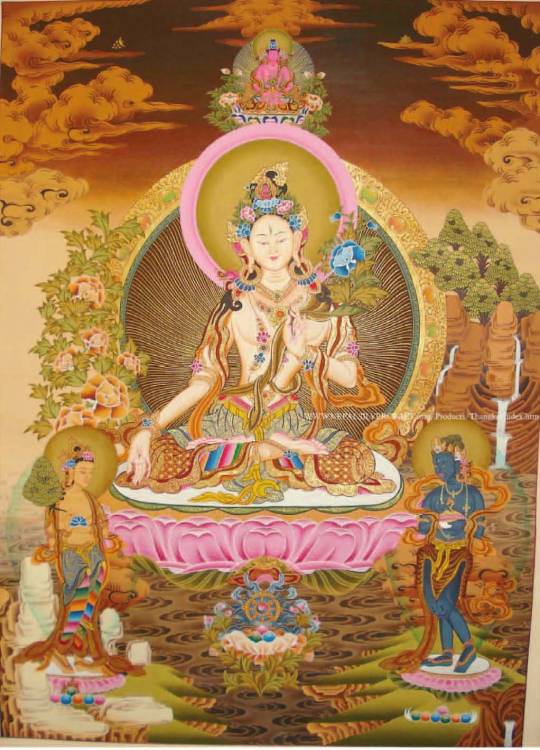
Tara Devi consort of Avalokitesvara

She is worshipped in Vajrayana Buddhism. The name Tara derives from the root word tar, which means “to cross” It is believed that Tara helps humanity cross the ocean of existence. Many legends have grown around this concept, and the most popular one is that a tear from the eye of Avalokitesvara fell in the valley beneath to form a lake; from the waters of the lake arose a lotus flower, out of which emerged Tara.
Other scholars hold that Tara’s name originates from the Persian wort sitara, meaning a luminous body in the sky.
Introduction of the Mother Goddess in the form of Tara is generally traced to the influence of Tantra. It is generally agreed that the devotion to Tara became firmly established during the sixth and seventh centuries C.E.
There are two principle varieties of Tara : white and blue/green. The former is shown with the full blown white lotus as her symbol, and the latter with the utpala (blue lotus). These forms respectively symbolize day and night, and her benign qualities of compassion and protection.
Besides the two types, a variety of other forms of the Goddess Tara are recognized in Tantric Buddhism, each having a distinctive color.
 - The Encyclopedia of Hinduism


~Anon I mus

“Be fully present with all your life challenges without the need to judge, overreact, justify or defend your ego. When drama finds you, simply slip out of the mind-identified state and hold onto the highest frequency of mindful presence.” 

Sayings of Te Toh


This little finger covers the eye and prevents the whole world from being seen.

In the same way this small mind covers the whole universe and prevents Reality from being seen.


—Ramana Maharshi


...


Sometimes I patrol the perimeter of life,

checking for holes where reality might leak in.


—Sayings of Te Toh (?)


Sri Ramana Maharshi

What is called ‘mind’ is a wondrous power residing in the Self.
It causes all thoughts to arise.
Apart from thoughts, there is no such thing as mind.
Therefore, thought is the nature of mind. 


Apart from thoughts, there is no independent entity called the world.
In deep sleep there are no thoughts, and there is no world.
In the states of waking and dream, there are thoughts,
and there is a world also. 


Just as the spider emits the thread (of the web) out of itself and again withdraws it into itself, likewise the mind projects the world out of itself and again resolves it into itself.
When the mind comes out of the Self, the world appears.
Therefore, when the world appears (to be real), the Self does not appear; and when the Self appears (shines) the world does not appear. 


When one persistently inquires into the nature of the mind, the mind will end, leaving the Self (as the residue).
What is referred to as the Self is the Atman. 


The mind always exists only in dependence on something gross;
it cannot stay alone.
It is the mind that is called the subtle body or the soul (jiva).


Franklin Merrell-Wolff

Aphorisms on Consciousness-without-an-object


1
Consciousness-without-an-object is.

2
Before objects were, Consciousness-without-an-object is.

3
Though objects seem to exist, Consciousness-without-an-object is.

4
When objects vanish, yet remaining through all unaffected, Consciousness-without-an-object is.

5
Outside of Consciousness-without-an-object nothing is.

6
Within the bosom of Consciousness-without-an-object lies the power of awareness that projects objects.

7
When objects are projected, the power of awareness as subject is presupposed, yet Consciousness-without-an-object remains unchanged.

8
When consciousness of objects is born, then, likewise, consciousness of absence of objects arises.

9
Consciousness of objects is the Universe.

10
Consciousness of absence of objects is Nirvana.